What is a craft beer? There are actually a lot of definitions, and there is even a legal definition, apparently. A craft beer is basically a beer that does not use rice or corn as a major ingredient. The craft beer movement started in the 1970s to get away from the beer created by the mega breweries (such as Budweiser, Miller, Coors, etc.). The problem with craft beers these days is that they are trying to do exactly what they originally were trying to get away from. They are trying to take over the market and become leaders in the industry. They started as regional breweries that provided original high quality products to the people of that region. I recently read a blog post from "Top Fermented" about this subject that I really liked. He stated that these breweries are throwing around the word "consistency" lately. This is the same word that the mega breweries throw around. Each Budweiser is supposed to taste exactly the same. It's not necessarily about making good beer as much as it is about making consistently tasting beer. What about consistently good beer?
The blogger even states that making a product that tastes exactly the same year after year shouldn't really be possible. Think about it. You're using organic materials that change from year to year, not to mention that yeast is a living organism, which reacts differently from batch to batch. Even if you use the same materials each time, there will most likely be a slight taste difference. Will it be similar? Of course. The same? No. And it shouldn't be expected to be. This is one of the principles behind home-brewing. One of the exciting parts of creating your own beer is that even if you make the same batch again, it will probably display different characteristics each time. The craft beer industry started with this idea in mind, but these companies have basically become smaller versions of the mega breweries. They are more interested in creating a flagship beer with a few supporting styles and marketing them across the country and even world-wide. Don't get me wrong; you start a business to make money. No one ever goes into starting a business with the intent to lose money. And people typically don't like change, so they don't want their favorite beers to change. However, I feel like this makes it harder for smaller, truly local breweries to provide their craft beers to the community.
I like the idea of craft beers. The whole idea of using corn or rice is to control the flavor of the product. Using malted barley and wheat, without using rice or corn, allows for the unique complexities of the beer to come out. I even think it's okay for the beer to be different from batch to batch. Isn't this the same for the wine industry? The same style of wine from different years is not expected to be exactly the same. That's why we put emphasis on labeling the years of the wine. Why can't we do this for beer?
The author of "Top Fermented" is starting a small brewery in NC. His mission is to create good beer that has variability, as all good beer does. I really like this and am excited about his brewery. If more breweries took this chance with their beers, the beer industry would be completely different. They would be getting back to actually creating "craft beers."
Check out his post at http://www.topfermented.com/2011/06/01/real-beer-has-variability-or-mystery-brewings-mission-statement/.
Until Next Time,
RHSC
Tuesday, June 14, 2011

Sunday, June 12, 2011
Stupid Bucket Lid...
Imagine what you would say if something suddenly went wrong with a project you had been working on for weeks...and that is probably what I said this past Friday night. After I transferred the porter (see Chocolate Macadamia Nut Porter post) from the primary to the secondary, something horrible happened. As I was placing the airlock into the rubber ring in the top of the lid, the ring fell into the batch. Panic ran through my mind like never before. I cursed...and then cursed some more. I quickly opened the bucket; maybe it was floating.
No such luck. It sank to the bottom.
I suddenly began thinking about having to toss the batch due to it being completely contaminated. However, I realized that there is a reason why I sanitize the entire lid and not just the underside that comes in contact with the beer (as a few people have told me is all that is necessary). I quickly washed and sanitized the primary and tubing, and re-transferred the beer back into the first bucket. I guess in the grand scheme of things, this was not the worst thing that could have happened, but what upsets me the most is how much beer I lost in the process. You always lose a little volume in the transfer, but I went from just over 5 gallons to less than 4.5 gallons on Friday. Hopefully, this won't contaminate the batch and it will still turn out well. It's just extremely irritating.
Damn.
Until Next Time,
RHSC
No such luck. It sank to the bottom.
I suddenly began thinking about having to toss the batch due to it being completely contaminated. However, I realized that there is a reason why I sanitize the entire lid and not just the underside that comes in contact with the beer (as a few people have told me is all that is necessary). I quickly washed and sanitized the primary and tubing, and re-transferred the beer back into the first bucket. I guess in the grand scheme of things, this was not the worst thing that could have happened, but what upsets me the most is how much beer I lost in the process. You always lose a little volume in the transfer, but I went from just over 5 gallons to less than 4.5 gallons on Friday. Hopefully, this won't contaminate the batch and it will still turn out well. It's just extremely irritating.
Damn.
Until Next Time,
RHSC
Friday, June 10, 2011
Beer Blogging Buddies
I recently joined this social network for beer bloggers called "Beer Bloggers Unite." It's a very cool site where all kinds of beer bloggers can get together and share ideas, recipes, beers they like/dislike, etc. I was immediately welcomed by a gentleman named Marcus who owns his own restaurant in Ellenville, NY. He has a video blog called "Beer Blogging Buddies," where he and two friends sample different beers and rate them on a score from 0-100. It is hilarious. Not only do they appear pretty knowledgeable about beer, but you can tell they really enjoy beer. You can also tell that they really enjoy each other's company. The one thing I really liked about them is that they don't appear to subscribe to trends. They like what they like and are unapologetic about it (that also goes for what they don't like). I really like this blog and have added it to the list of blogs I'm following. It's a lot of fun and I recommend everyone give it a try. You can follow the link below:
http://beerbloggingbuddies.blogspot.com
Until Next Time,
RHSC
http://beerbloggingbuddies.blogspot.com
Until Next Time,
RHSC
Wednesday, June 8, 2011
Kegerator
Over the past couple of weeks I have been looking into kegging my beer. I have come to the conclusion that bottling is tedious and takes a really long time. Beer usually has to condition in bottles for at least 10-14 days, whereas keg conditioned beer only needs about 5 days. Also, force carbonating the beer is really the only way to ensure that each beer is consistently carbonated. I recently purchased a keg refrigerator, or kegerator. I've been pricing kegerators, online and on Craig's List, and finally came across one for sale at an antique shop in Raleigh. The owner wasn't even really aware of what he had. It is an old U-Line "Keg-Meister" complete with tower and CO2 tank. This model was discontinued around 1994 or 1995. It was rusted, dirty, and in need of lots of work, but worked fine and got cold in a hurry. It also has tons of space. It will easily hold two 5-gallon Cornelius (corny) kegs. He was asking $295, but I got him down to $250 once I told him about all the parts I was going to have to replace and modify for home-brew kegs (it was set-up for commercial kegs). I jumped on it immediately.
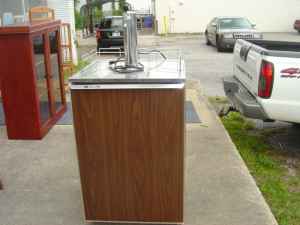

What I've Done So Far:
- Scrubbed down all the exterior metal--it looks silver again
- Scrubbed the interior--it's still rusted, but not as bad as it was
- Cleaned and scrubbed the drip tray and drain
- Replaced the beer line
- Soaked and cleaned the shank and faucet
- Replaced the commercial couplers (gas-in and beer-out) with ball-lock couplers for corny kegs
- Replaced the regulator and gas hose for the CO2 tank.
- Found a Sam Adams tap handle and put it on instead of the little black knob it came with
I eventually want to replace the tower with one that has two faucets so that I can tap two kegs at once. I'm not sure that I'll keep this one forever, but it's a great start. I already have a keg and am planning to keg condition my latest batch (see the Chocolate Macadamia Nut Porter post). It's a great investment and I've been told by many who have made the same leap that I got a great deal. Pictures below.
Until Next Time,
RHSC
Sunday, June 5, 2011
Chocolate Macadamia Nut Porter
This past Friday, a group of friends came over and helped me brew this latest batch. I've been trying ever since Beer Fest to create a recipe for this type of porter after I tried the Gallows Point Dead Man's Porter, which was a chocolate macadamia nut flavored beer. Since then I have been anxious to find a recipe that recreates this beer. I couldn't find one anywhere. I looked through various recipe books and even online to no avail. So, this is basically an original recipe that I came up with based on a couple of basic porter and chocolate porter recipes.
Ingredients:
Ingredients:
- 4.3 lbs Dark Malt Extract
- 3 lbs Amber Malt Extract
- 0.5 lb Crystal Grain (90 L)
- 0.5 lb Chocolate Malt
- 0.25 lb Black Patent Malt
- 1.5 cups Molasses
- 9 oz Bittersweet Baking Chocolate (60% Cacao) (melted) (adjust amount based on desired sweetness)
- 1 cup Chopped Macadamia Nuts (roasted)
- 1.5 oz Northern Brewer Hops
- 1.5 oz Cascade Hops
- American Ale Yeast
Instructions:
- Steep grains at 150-160F for 30-60 minutes.
- Bring to boil and stir in extract, molasses, and Northern Brewing hops. Boil for one hour.
- At 45 minutes left, stir in half of the macadamia nuts.
- At 30 minutes, stir in the melted chocolate. Stir frequently to prevent the chocolate from burning.
- At 15 minutes, stir in the rest of the nuts.
- After one hour, remove the wort from heat and steep the Cascade hops for 10 minutes.
- Chill wort quickly and add to fermenter.
- Pitch yeast.
- Ferment in primary for 7-10 days.
- Transfer to secondary for 7-10 days.
OG = 1.060
I have invested in a kegging system (blog post on the way), so I will not be bottling this batch. I will transfer to a keg and force carbonate for about 5 days. However, if you want to bottle, you will boil 3/4 cup of corn sugar to 2 cups of water for a priming solution and bottle for 10-14 days. I am very excited about this batch, especially since I will be kegging. Once it is ready, I will post an update.
Until Next Time,
RHSC
Tuesday, May 17, 2011
Weekend Update
A lot happened this past weekend, so I'm just going to combine it all into one post. Sorry if it's kind of long.
Citrus Wheat Beer:
The wheat beer I posted about earlier is ready. It's got a nice citrus aroma and the right amount of hops up front, but the finish is a little weak; there's something missing on the end. I like some of the changes I made from the first batch, but I think I may need to go revisit my first recipe and mix and match a little. Overall this is a nice beer, and is very refreshing. It's not too sweet or bitter. It really would be perfect if it had the right finish.
Beer Fest:
Some friends and I went to Beer Fest in Gastonia, NC at the Gastonia Grizzlies minor-league baseball park. Aside from some rain, it was a pretty fun event. There were over 100 beers, some wine, and cider from various breweries and wineries present. I stuck mostly with the beer, though I did try some of the other options available. I do not really remember all of the beers I tried, but several do stick out in my mind (good and bad).
Citrus Wheat Beer:
The wheat beer I posted about earlier is ready. It's got a nice citrus aroma and the right amount of hops up front, but the finish is a little weak; there's something missing on the end. I like some of the changes I made from the first batch, but I think I may need to go revisit my first recipe and mix and match a little. Overall this is a nice beer, and is very refreshing. It's not too sweet or bitter. It really would be perfect if it had the right finish.
Beer Fest:
Some friends and I went to Beer Fest in Gastonia, NC at the Gastonia Grizzlies minor-league baseball park. Aside from some rain, it was a pretty fun event. There were over 100 beers, some wine, and cider from various breweries and wineries present. I stuck mostly with the beer, though I did try some of the other options available. I do not really remember all of the beers I tried, but several do stick out in my mind (good and bad).
- The Good
- Gallows Point Dead Man's Porter by Skull Coast Ale Company
- Jah*va Imperial Coffee Stout by Southern Tier Brewery
- Endless River by Mother Earth
- Copper Ale by Old Mecklenburg Brewery
- Harpoon's Summer Seasonal
- Woodchuck Summer
- Shocktop and Shocktop Summer
The Gallows Point porter was my favorite followed closely by the Jah*va stout. The porter had a great flavor and wasn't overly bitter or thick as porters can be. It had great chocolate and macadamia nut flavors that I've just never tasted before in a beer. I immediately wanted to begin experimenting with this to create my own version.
The Jah*va was also amazing. You could taste the coffee right up front, with some subtle chocolate and even raisin flavors in the back. This was very nice--almost like a novelty coffee drink. I also noticed some caramel flavors. However, at 11% ABV, this is something to sip, maybe as an after-dinner drink.
Endless River, Copper Ale, Harpoon's Summer and Woodchuck Summer were all very nice, smooth beers (and one cider). They weren't the same type, but they are widely available so I won't go into much detail. Try them for yourself.
I have actually begun to like Shocktop here lately. The seasonal was also good, which is saying a lot because it was a raspberry wheat beer, and I don't like raspberries. There's just something very refreshing about Shocktop--I really like that they have stayed true to the original style of wheat beers and have left it unfiltered. That's a nice touch not a lot of breweries do.
- The Bad
- Olde Hickory Brewery
- eBrew.com
- Foothills Brewery
- Blueberry Porter from Ass-Clown Brewery
- Bottle-Tree Blonde
I want to clarify that I am listing OHB on this list not necessarily because their beers were the worst I tried, but because of how disappointed I was. I love this brewery. They have a huge beer selection at their brew-pub in Hickory, yet they only brought two beers: a pilsner and an IPA that I honestly think might have been the same beer. They tasted so similar and overly hoppy that it was hard to tell them apart.
EBrew.com is a distribution company that purchased home-brew beer and wine for this event. As a home-brewer, I was insulted at what they brought. I didn't like any of it, particularly this Black-Eye PA. It was basically a stout and an IPA combined and was rather horrid.
The Foothills Brewery did not impress me. I had never tried any of their beers, but nothing really stood out. They were all incredibly hoppy; even their hefeweisen was very hoppy.
The Blueberry Porter from Ass-Clown was probably the worst beer of them all. It just didn't taste right. The flavors were out of order. I think I would have rather had the bitter dark chocolate taste up-front with a smooth, sweet finish. Instead, you get a jolt of sweet blueberries right up front, which is off-setting because of the bitter aroma, followed by an extremely bitter chocolate after-taste. It just didn't sit right on the palate.
The Bottle Tree Blonde is really only on this list because they served me a warm Carolina blonde ale, and did so knowingly. "Oops, this bottle's warm, but it'll be all right. Here you go!" Not okay. It probably would have been a very nice beer.
Overall, I really enjoyed this festival. It was a nice atmosphere and a lot of fun. Some things that would have made it better: food vendors, and smaller samples. It would have been nice to get a snack in the middle of the tasting. As far as the sample sizes go, we were only given 6 oz tasting glasses, but so many of the people were filling them to the brim. This is a tasting. I'm not ordering a drink. What if I don't like it? Now, I have to drink the rest of it, or go out of view to dump it so as not to offend anyone. I was even dumping beers I liked because I wanted to be able to taste a lot of different beers. I can't do that if I'm drunk. Also, I will say that there were a lot of IPA's at this event. I am not an IPA fan, as you can probably tell. I just don't like the upfront bitter punch of hops. I don't mind bitter beers, but I like the flavor of malts and hops...not just hops. I like stouts because that dark malt flavor counteracts the bitterness of the hops. However, there were still plenty of beers at the festival that were right up my alley.
Glass Carboy
Two of my friends, who went to Beer Fest with us, gave me a 6 gallon glass carboy for my birthday over the weekend. This is an awesome addition to my equipment, which I'm sure I will be able to use very soon!
Until Next Time,
RHSC
Wednesday, April 27, 2011
Citrus Wheat Beer (Round 2)
This is a revised version of a wheat beer I made last fall. You can find the post here on the blog entitled "Citrus Wheat Beer." I made a few changes, trying to play off the great flavor I got last time while trying to add more wheat flavors to make it more of an "authentic" wheat beer. I brewed this batch last Thursday. Hopefully it will turn out as successful as the first try.
Ingredients:
6.6 pounds Wheat Malt Extract
1 pound Wheat Grain (85 L)
1 pound Flaked Wheat (2 L)
1 ounce Liberty Hops
2 Oranges, Sliced
Zest of 1 Lemon
1 package (11 g) of American Ale Yeast (S-33)
3/4 cup of Corn Sugar (priming)
Instructions:
I will let you know how it turns out once I've tried it.
Until Next Time,
RHSC
Ingredients:
6.6 pounds Wheat Malt Extract
1 pound Wheat Grain (85 L)
1 pound Flaked Wheat (2 L)
1 ounce Liberty Hops
2 Oranges, Sliced
Zest of 1 Lemon
1 package (11 g) of American Ale Yeast (S-33)
3/4 cup of Corn Sugar (priming)
Instructions:
- Steep grains and wheat at 150 F for 30-60 minutes.
- Stir in malt extract. Bring to boil for 1 hour.
- Once wort begins to boil, add hops.
- Add oranges in last 10-15 minutes of boil.
- Add lemon zest in last 5-7 minutes of boil.
- Chill wort quickly and add to fermenter.
- Pitch yeast and seal fermenter.
- Ferment in primary for 7 days.
- Transfer to secondary fermenter. Let sit for 7 more days.
- Boil corn sugar in 2 cups water for priming solution.
- Pour priming solution into bottling bucket.
- Transfer wort from secondary to bottling bucket. Let sit for 2-5 minutes. Bottle.
- Let beer stand in bottles 10-14 days.
I will let you know how it turns out once I've tried it.
Until Next Time,
RHSC
Subscribe to:
Comments (Atom)